Card Show Vendor Tables That Actually Move
The first thing people notice at a show is not your best card - it is your table. In a room full of noise, slabs, bargain boxes, and buyers scanning every aisle, card show vendor tables either pull people in or get passed in three seconds. If you are paying for space, bringing inventory, and putting in a full weekend, your setup needs to work as hard as you do. A strong table does not mean flashy for the sake of flashy. It means clear, organized, easy to shop, and built for the way collectors actually buy. Some attendees want a quick dollar-box run. Others are hunting grails, testing comps in real time, or looking to trade up. The best vendors know their table has to serve all of them without feeling cluttered or confusing.
5/29/20265 min read
What makes card show vendor tables work
At a busy show, attention is earned fast. Buyers are making snap decisions from the aisle. If your display looks chaotic, overpriced, or hard to browse, many of them keep moving. If it looks active, fair, and approachable, they stop.
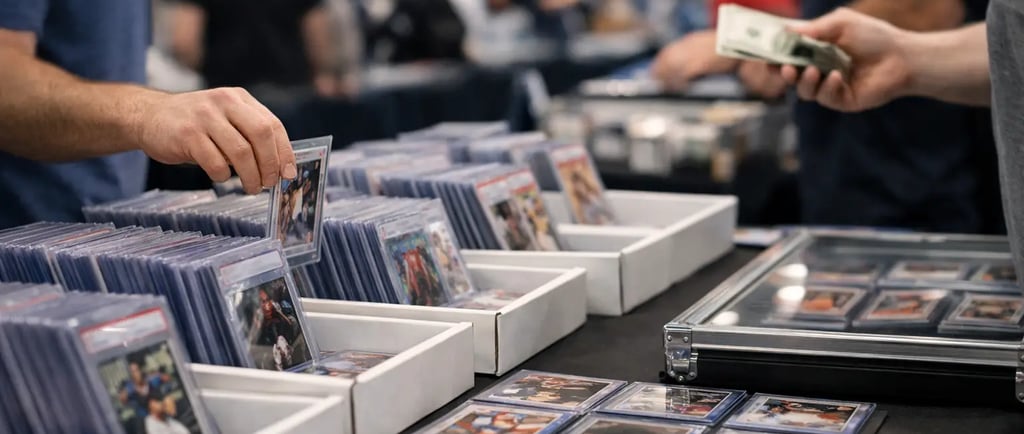
That is why the most effective tables usually get three things right. First, they create a clean visual lane from the aisle to the product. Second, they make pricing easy enough that people do not feel awkward picking things up. Third, they give the shopper more than one way to engage, whether that is value boxes, mid-end raw, graded stars, or a showcase piece that starts conversations.
This matters even more at larger regional events, where attendees expect variety and pace. A table that works at a small local mall show may feel thin at a major event. On the other hand, a table loaded with high-end inventory and no entry point can also miss a big part of the crowd. It depends on your customer mix, but the goal is the same - give people a reason to stop and a simple path to buy.
Build your table around how collectors shop
Most buyers do not arrive at your table in the same mode. One person is hunting a Saints auto. Another wants vintage baseball. A kid may be chasing Pokémon hits with birthday money. A reseller may be looking for underpriced slabs or bulk opportunities. Card show vendor tables perform better when they reflect that reality.
Think in zones instead of piles. Your front edge should invite casual traffic with easy-to-browse boxes or clearly marked low-to-mid inventory. The center should carry the cards that represent your main lane, whether that is sports, TCG, vintage, wax, or memorabilia. Your premium inventory should be visible, but not so dominant that it scares off people who assume everything on the table is out of reach.
This is where many vendors leave money on the table. They bring good inventory but present it in a way that only one type of buyer understands. If your whole setup says, "serious buyers only," you may miss dozens of smaller deals that add up fast. If your whole setup looks bargain-only, high-end buyers may never ask what else you have behind the table.
Clear pricing beats constant explaining
Collectors want to ask questions about the cards, not guess whether they can afford them. Price stickers, section labels, and signs for boxes do more than save time. They lower friction. People pick up more cards when they know what range they are shopping.
That does not mean every single item needs a sticker if your inventory turns fast. But the table should still communicate enough that buyers can self-start. A sign that says "$1 each or 7 for $5," a slab case with visible prices, or dividers by team and category can dramatically improve engagement.
If you prefer flexibility because the market moves, that is fair. Still, there is a trade-off. No visible pricing can create room for negotiation, but it can also make buyers assume every card will require a long back-and-forth. At a packed show, that hesitation costs you traffic.
Make it easy to browse without crowding
Collectors slow down at tables that feel shop-able. They speed up past tables that feel like work. Tall stacks, overfilled cases, and random loose cards can make even strong inventory look weaker than it is.
Use vertical elements carefully. Stands for featured slabs or signage can help, but if they block sight lines, they work against you. Keep the front area open enough that two or three people can browse without bumping into each other. If families attend the show, leave room for younger collectors too. A table that feels welcoming gets more touches, and more touches usually lead to more deals.
Inventory mix matters more than sheer volume
Big inventory sounds impressive, but smart inventory sells. The strongest card show vendor tables are not always the fullest. They are the ones with a balanced mix that matches the room.
At a broad regional event, variety wins. Sports cards, Pokémon, Magic, vintage, modern rookies, autographs, graded slabs, and even adjacent categories like memorabilia or coins can all have a place if they are organized well. But variety without structure feels random. Buyers need to understand what you carry in seconds.
It also helps to think about your inventory in terms of momentum. Low-end boxes create activity. Mid-range cards generate repeat looks. Showcase cards create credibility and conversation. Wax can pull in sealed-product buyers, while team lots or player sections help collectors who want to move quickly. If all your inventory sits in one narrow price band, you limit your day.
The best tables tell a story fast
A shopper should be able to glance over and know your lane. Are you the vintage baseball table? The bargain-box grinder table? The modern slab table? The TCG table with strong singles? The more clearly you present your identity, the more likely the right buyers are to stop.
That does not mean you should only carry one category. It means your presentation should have a center of gravity. If everything competes for attention, nothing stands out.
Selling is only part of the job
Great vendors do not just display cards well. They work the room well. They greet people, stay approachable, and know when to let a collector browse in peace. Energy matters.
This is one reason in-person shows still matter so much in the hobby. People are not only buying cardboard. They are buying trust, conversation, and a better feel for condition, authenticity, and market reality. Strong card show vendor tables support that face-to-face advantage. Buyers remember the dealer who was fair, prepared, and easy to deal with.
There is also a networking side that newer vendors sometimes overlook. A table is not only a sales space. It is a business card in physical form. Other dealers may approach you about trades, bulk buys, future partnerships, or inventory leads. Hobby shops may remember your presentation. Repeat customers may circle back later in the day after seeing the rest of the room. The way you run your table shapes all of that.
Why table choice can change your weekend
Not every table location performs the same, and not every vendor needs the same setup. Corner spots can help visibility. Main-aisle exposure can boost walk-up traffic. Multi-table setups give you room to separate categories or create a better buyer flow. But a bigger setup only helps if you can fill it without making it look empty.
That is where planning matters. If your inventory is deep and broad, more space can increase both sales and comfort. If your stock is tighter, one well-built table often beats two weak ones. The right move depends on what you sell, how you display it, and whether your goal is volume, branding, or a mix of both.
For vendors across Louisiana and the Gulf South, strong regional events give you a chance to meet serious hobby buyers without relying on scattered local traffic. A well-run show brings concentration - more collectors, more categories, more energy, and more chances to move inventory in person. That is exactly why vendors who want real momentum tend to get their spots early, especially at destination-style events like Gulf South Card Show.
Prepare before the doors open
The best weekends usually start before setup day. Know your prices, sort your boxes, bring supplies, and think through your checkout flow. Top loaders, sleeves, bags, change, labels, markers, and backup power for devices are not glamorous, but they keep deals moving.
Bring enough inventory to refresh the table if traffic is strong. A picked-over display loses energy. Rotating in fresh cards midday can give your table a second wave. That said, do not overload just because you can. The best restock is intentional, not random.
And if you want to stand out, remember this - the hobby notices effort. Clean presentation, fair dealing, and a table built for real collectors send a message. You came to do business, connect with the community, and be part of something bigger than one weekend’s sales.
The vendors who win at shows are not always the loudest or the biggest. They are the ones who make it easy for collectors to stop, shop, talk, and come back for one more look.