Are Sports Cards Worth Anything Today?
You found a stack of old cards in a closet, a binder in the garage, or a shoebox your uncle swore would pay for college one day. So the question hits fast: are sports cards worth anything? Sometimes yes. Sometimes not much at all. And sometimes one card in an otherwise ordinary pile is the one that changes the whole conversation. That is why guessing is where collectors lose money. Condition, player, year, brand, scarcity, grading, and timing all matter. A card can look old and still be common. Another can look plain and be quietly valuable because it is a short print, a key rookie, or a tough parallel that serious collectors chase hard.
5/27/20265 min read
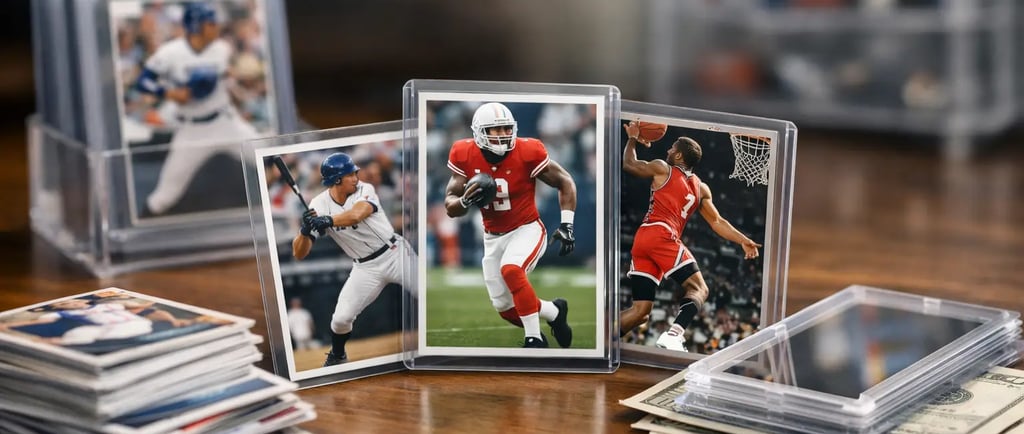
Are sports cards worth anything, or mostly hype?
The honest answer is both. Sports cards absolutely can be worth real money, but value is not spread evenly across every box, binder, and estate lot. Most mass-produced cards from the late 1980s and early 1990s are famous for one reason - there are just too many of them. That era created plenty of nostalgia, but nostalgia alone does not create scarcity.
On the other hand, cards tied to all-time great players, true rookie cards, low-numbered parallels, on-card autographs, vintage stars, and rare inserts can still command strong prices. Even modern cards can be worth a lot if the player breaks out, the print run stays tight, and the card grades well.
So if you are looking at a collection, the better question is not whether sports cards have value in general. It is what kind of cards you actually have, and whether the market still cares about them.
What actually makes a sports card valuable?
Value usually comes from a combination of demand and scarcity. If nobody wants the player, the card will struggle no matter how sharp it looks. If everybody wants the player but the card was printed by the millions, the ceiling may still stay low.
The strongest cards usually check several boxes at once. Rookie status matters because collectors often treat a player’s early cards as the hobby benchmark. Star power matters because Hall of Famers, all-time greats, and current stars have deeper buyer pools than role players. Scarcity matters because low print runs, serial numbering, short prints, and hard-to-find inserts give collectors a reason to compete.
Condition is the force multiplier. Centering, corners, edges, and surface can turn a decent card into a premium one or knock a promising card down fast. That is why two copies of the same card can sell for dramatically different prices.
Grading adds another layer. A graded card from a respected company can sell for more because the buyer has more confidence in what they are getting. But grading is not magic. If the card is common or already flawed, the grading fee may cost more than the increase in value.
The cards most likely to be worth something
If you are sorting through a collection, start with the categories that tend to hold interest year after year.
Vintage stars are always worth checking. Older cards of iconic names have a built-in collector base, especially if the card is from a recognized set and still presents well. Even lower-grade vintage can attract buyers because true age and historical significance carry weight.
Key rookies are another priority. Collectors chase first-year cards of major names in baseball, basketball, football, and hockey. The bigger the career, the stronger the long-term demand. A rookie card of a legend has a very different market than a fifth-year base card of a good player.
Autographs, memorabilia cards, refractors, numbered parallels, and case hits deserve attention too. In modern products, these are often the cards that separate a fun rip from a meaningful pull. But not every autograph is equal, and not every patch card is rare. A low-numbered autograph of a top prospect is one thing. A high-print relic of a marginal player is another.
Cards of current stars can also carry strong value, especially during breakout seasons or playoff runs. That said, modern prices can swing hard. A player’s market can rise quickly, but it can cool just as fast after an injury, slump, or change in hobby attention.
Why so many old sports cards are not worth much
This is where expectations need a reality check. A lot of collections from the junk wax era look impressive because they are full, organized, and packed with familiar names. But supply is the problem. When millions of copies exist, collectors can afford to be picky, and prices stay low unless the card is in elite condition or tied to a truly iconic player.
That does not mean those cards have no place in the hobby. They are great for nostalgia, team sets, starter collections, and budget-friendly collecting. But if the goal is resale value, many of those cards will not bring the numbers people remember hearing about during hobby booms.
This is also why sentimental value and market value are different things. A card can be priceless to your family and still sell for only a few dollars. That is not bad news. It is just the market being the market.
How to tell if your sports cards are worth anything
Start by slowing down. Do not rush to sell a whole collection for one number just because someone offers quick cash. Pull out rookies, stars, Hall of Famers, autographs, numbered cards, vintage pieces, and anything already graded.
Then look closely at the card details. Year, manufacturer, set, card number, and player matter. Variations matter too. A base card and a short print from the same product can look similar at a glance but live in totally different price ranges.
Condition comes next. Check for soft corners, edge chipping, surface scratches, print lines, stains, and poor centering. For modern chrome-style cards, surface issues can be especially costly. For vintage, centering and creases often drive major price differences.
After that, compare actual recent sale prices, not hopeful asking prices. Asking prices can be fantasy. Completed sales show what buyers really paid. If you are looking at graded copies, make sure the grade matches what you are comparing. A PSA 10 price tells you very little about a raw card with touchy corners.
If you are unsure, bring the cards to a trusted in-person show or dealer for a second opinion. Face-to-face conversations can save you from underpricing something rare or overestimating something common. At a strong regional event like Gulf South Card Show, that kind of real-time feedback is part of the value. You are not relying on one opinion in a vacuum.
Should you grade your cards before selling?
Sometimes. Not always.
Grading makes the most sense when the card already has demand, appears clean enough to earn a strong grade, and has enough upside to justify the fee and wait time. If a card jumps significantly in value as a 9 or 10, grading can be a smart move. If it is a common card with obvious wear, it usually is not.
There is also risk involved. A card that looks great in a sleeve can still come back lower than expected because of surface issues or centering. For some sellers, moving a desirable raw card quickly is better than gambling on a grade.
That is where experience matters. Collectors who handle cards often get better at spotting grade-worthy candidates. Newer sellers should be cautious, especially with large submissions.
The market is real, but timing matters
Sports cards are not a fixed-price asset. Markets move with player performance, Hall of Fame momentum, team success, media attention, and hobby trends. Selling a quarterback during playoff hype is different from selling after a rough season. The same goes for prospects. One hot month can create real demand, but prospect markets can cool fast if production does not follow.
Vintage tends to behave differently. It is often more stable because the supply is known and the collector base is established. Modern can be more explosive, but it can also be more fragile. That trade-off matters if you are deciding whether to hold or sell.
If you are asking whether sports cards are worth anything because you want a simple yes or no, the market will frustrate you. If you treat value like a mix of scarcity, condition, player strength, and timing, the picture gets much clearer.
A dusty box of cards might be bulk. It might be a gold mine. Most often, it is a little of both. The move is not to assume the best or the worst. The move is to sort carefully, learn what collectors are actually chasing, and put your cards in front of people who know the difference. That is where value stops being a guess and starts becoming a real opportunity.