How to Trade Sports Cards Like a Pro
That moment happens fast. You spot a card you want, someone eyes the stack in your case, and now the question is on the table - cash, trade, or trade plus cash? If you want to know how to trade sports cards without getting burned, overpaying, or missing a strong deal, you need more than comps. You need a plan, a little discipline, and the confidence to work the room. Trading is one of the best parts of the hobby because it turns collecting into a real conversation. It is how collectors move into new players, new teams, new eras, and better cards without always pulling out their wallet. At the same time, bad trades happen every day because people move too quickly, fall in love with one card, or forget that condition and liquidity matter just as much as headline value.
5/29/20265 min read
How to trade sports cards without making rookie mistakes
The first rule is simple: know what you have before you start negotiating. That means checking recent sales, understanding the condition of your cards, and being honest about what actually moves in the market. A card can book well in your head and still sit in a case all weekend if demand is thin.
Raw cards and graded cards do not trade the same way. A graded rookie of a star quarterback has a clearer market than a raw insert with soft corners, even if both look great at first glance. Liquidity matters. The easier a card is to resell or retrade, the stronger it usually is in a deal.
You also want to separate personal value from market value. Maybe that Ja Morant rookie means a lot to you because you pulled it yourself. That is real to you, but it does not change what another collector is willing to give up. Good traders know the difference and keep emotion from turning a fair deal into a bad one.
Start with comps, but do not stop there
Recent sales are the backbone of any trade, but comps are not the whole story. You need context. Was that sale an auction that ended at 2 a.m.? Was it a buy-it-now from a motivated seller? Was the card centered well, clean on the surface, and likely to grade higher than average? Those details change how people value the same card.
When you are building a trade, use comps as a range instead of a single hard number. If a card has sold from $80 to $110 over the last few weeks, do not act like it is locked at $95 on the dot. The cleaner the card, the hotter the player, and the stronger the eye appeal, the more room there is near the top of that range.
This is also where timing matters. In-season football and playoff basketball can push values fast. Trading for a player after a huge performance usually costs more. Trading for talent in a quiet period can be smarter, but it also takes patience because not every collector wants to move a card when hype is down.
Know the four things people really trade for
Most deals come down to some mix of player, condition, rarity, and liquidity. A card does not need to win all four categories, but it should win enough to make sense.
Player value is obvious. Star power drives interest, and hobby favorites usually hold stronger trade appeal than mid-tier names. Condition is next because flaws shrink your pool of interested buyers. Rarity helps, but only if people actually want the card. A low-numbered card of a cold player can still be tough to move. Liquidity is the tiebreaker. If one card is easier to move next week, it often carries more practical value right now.
Build trade bait on purpose
If you only carry cards you never want to move, trading gets hard. Strong traders keep a mix of personal collection cards and trade bait. Trade bait should be desirable, easy to comp, and broad enough to interest different collectors.
That might mean popular rookies, graded stars, low-numbered parallels, team lots, or clean mid-end cards that sit in the sweet spot of affordability and demand. Not every deal is for a monster card. Plenty of good trades happen in the $20 to $200 range because both sides can move without overthinking every detail.
Presentation helps more than people admit. Keep cards organized, sleeved correctly, and easy to flip through. If someone has to dig through a messy box to figure out what you have, you are already losing momentum. A clean case or binder signals that you take the hobby seriously.
How to trade sports cards in person
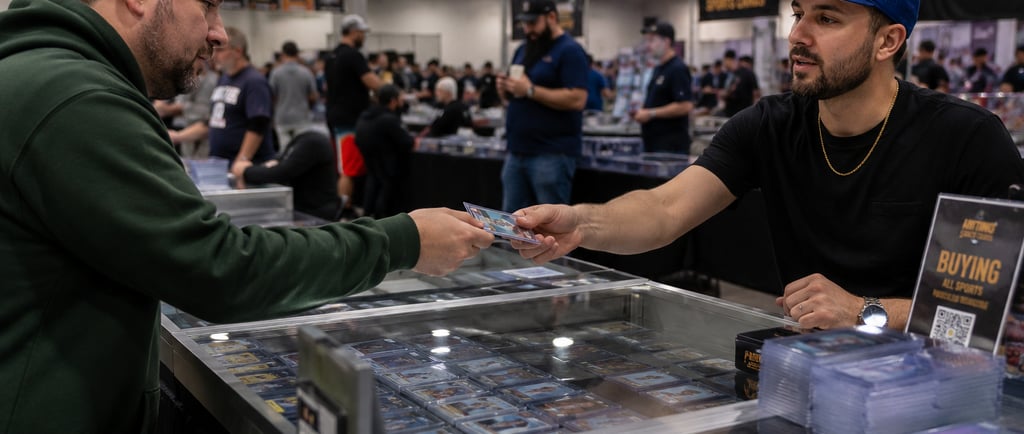
Face-to-face trading is where the hobby comes alive. You can read reactions, inspect condition in real time, and work through different structures until both sides feel good about the deal. That makes live events one of the best places to sharpen your trade game.
Start with a simple question: what are you looking for? That saves time and shows respect. Some people want quarterbacks only. Some are hunting vintage. Some want to consolidate. Others want to break a bigger card into several easier-to-move pieces. If you know their goal, you can shape a real offer instead of throwing random cards on the table.
Do not lead with your absolute best card unless the target demands it. Let the conversation develop. Show enough to create interest, then narrow in. Good negotiating is not about pressure. It is about fit.
Be ready for trade plus cash. This is one of the most common ways to bridge a gap, especially when values are close but not perfect. If your side is light by $40, adding cash can save a deal that makes sense for both people. There is nothing wrong with that. In fact, it often leads to cleaner, more honest trades.
Inspect every card like you are buying it
Even if the trade feels friendly, check corners, edges, surface, and centering. Take the card out and look at it under decent light if the other person is comfortable with that. A tiny surface scratch or soft corner can be the difference between a strong trade chip and a card you struggle to move later.
For graded cards, inspect the slab too. Cracked cases, heavy scratches, or signs of tampering matter. A grade on the label helps, but the full item in your hand is what you are actually accepting.
Negotiation that keeps doors open
The best hobby relationships come from fair dealing, not from squeezing every last dollar out of one trade. If you treat every conversation like a street fight, people remember. If you are reasonable, transparent, and easy to work with, people come back around.
That does not mean you have to say yes. Passing is part of smart collecting. If a trade feels too high, too rushed, or too tilted by hype, thank them and move on. There will always be another card.
It also helps to say what problem you are trying to solve. Maybe you are trimming down one player. Maybe you want more liquidity before the next show. Maybe you are moving into vintage because modern feels too volatile. When people understand your angle, they can often build a better offer.
Online trades need extra caution
Trading online can work, but trust becomes the whole game. Clear photos, coined images, references, tracking, insurance, and agreed values all matter. If any part feels vague, slow it down.
The biggest issue online is not always fraud. Sometimes it is disagreement. One person says near mint, the other sees whitening and a print line. That is why precise photos and plain communication matter so much. If you would be frustrated receiving the card as shown, do not send the offer.
Trade up, trade down, or stay balanced?
There is no single right strategy. Trading up into one bigger card can make sense if you want quality, fewer moving pieces, and stronger long-term appeal. Trading down can make sense if you need inventory, flexibility, or easier resale options. Staying balanced works well if you collect for fun and want a little of both.
It depends on your goals. A dealer may prefer liquidity. A collector may prefer consolidation into grails. A weekend hobbyist may simply want cards they are excited to bring home. All three approaches can be smart if the values and purpose line up.
At a strong live event, you see that in real time. One table is chasing graded vintage. Another wants bargain boxes and prospects. Another is loaded with slabs and looking to turn one large card into several faster movers. That is part of what makes a packed room so valuable - there is more than one way to make a good deal.
If you are working the floor at Gulf South Card Show, bring trade bait that matches the crowd, know your numbers, and stay open to different structures. The best deals are not always the loudest ones. Often, they are the trades where both sides leave feeling like they got closer to the collection they actually want.
A smart trade should feel good two days later, not just in the moment. That is the standard worth keeping every time you open your case.